Targeting the Metabolic Vulnerability of Resistant Cancer
Cancer cells that develop resistance to standard therapies often shift to oxidative phosphorylation as their primary energy source. That dependency is their vulnerability — and lixumistat is designed to exploit it.
Acquired Resistance Leaves Patients Without Options
Across tumour types — pancreatic cancer, glioblastoma, melanoma, breast cancer — patients who initially respond to treatment will often relapse. When resistance develops, it frequently involves a metabolic shift: cancer cells rewire to depend on oxidative phosphorylation for energy production.
This metabolic rewiring is not a defence against lixumistat. It is the target.
A clinical scenario in which a cancer initially responded to anti-cancer therapy but then relapses and disease progresses
The Mechanism
OxPhos Inhibition — Blocking Cancer's Backup Energy Source
Normal cells balance energy between glycolysis and oxidative phosphorylation. Treatment-resistant tumour cells often become heavily OxPhos-dependent. Lixumistat is a selective Complex I inhibitor that targets this pathway directly, with a well-established safety profile across completed Phase 1 studies.
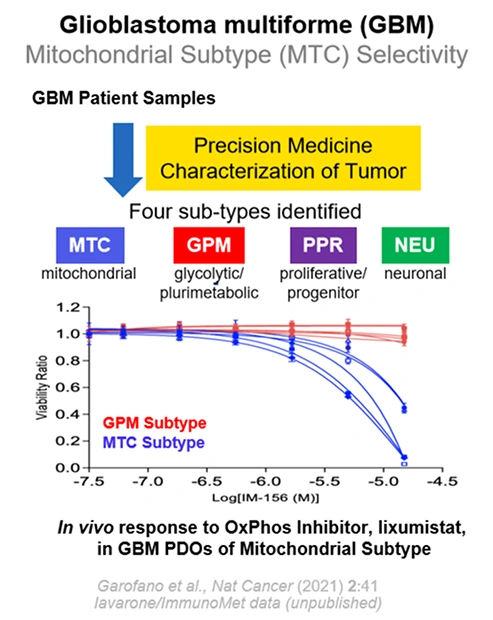
OxPhos dependence has been documented across multiple cancer types where acquired resistance has developed. ImmunoMet’s current clinical focus is pancreatic cancer, with glioblastoma as the next planned indication.
Tumour Types
Pancreatic Cancer
Phase 1b/2a active · MD Anderson
Next Indication
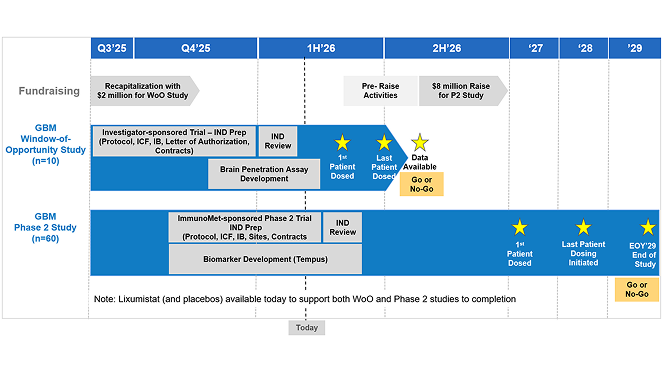
Glioblastoma (GBM)
IND preparation underway
Pre-Clinical Data
Melanoma
BRAF/MEKi-resistant models
Pre-Clinical Data
Breast Cancer
ER+, endocrine/CDK4/6-resistant
Sources: Janku et al., Inv New Drugs, 2022. El-Botty et al., Nature Communications, 2023 (breast). Gopal et al., Clin Cancer Res, 2019 (melanoma). All cited in investor deck.